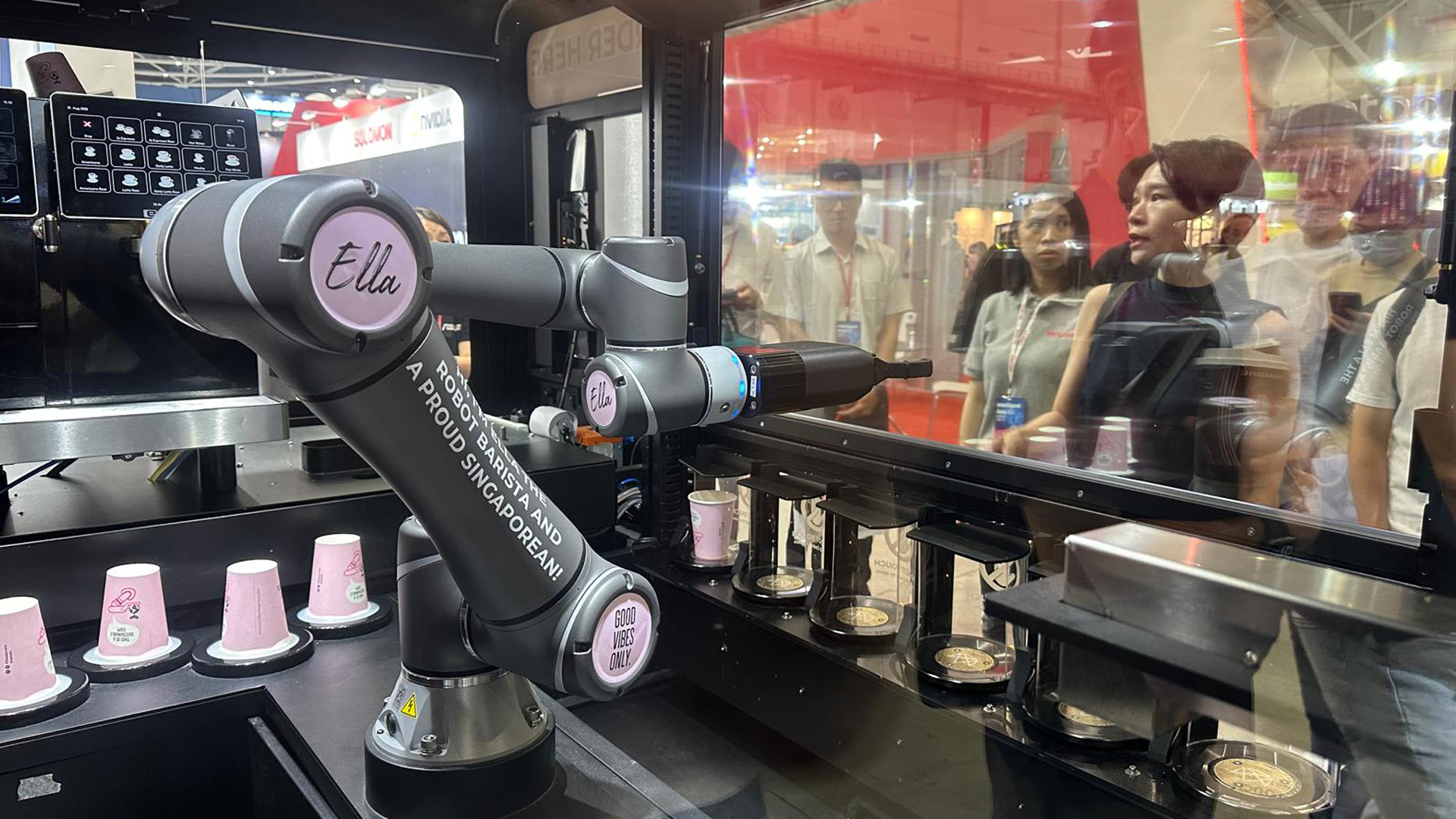
Here’s a stat to make you blink: the discrete GPU powering a robot barista like Ella can cost more than the entire robot itself. That’s right. For every fancy latte conjured by an automated arm, the biggest expense might not be the sophisticated mechanics, but the oversized brain juice required to make it think. Intel, bless their silicon hearts, thinks they’ve got a fix with their new Core Ultra Series 3, promising to shrink that expensive brain and bring AI to the edge without emptying the bank.
The ‘Ella’ Effect: A Latte of Cost Savings
You know the drill. Overworked baristas, high turnover, the endless quest for a decent cup of coffee. Keith Tan, founder of Sensory AI and the brains behind the Ella robot barista, lived this pain. His solution? Robots. But equipping them for complex tasks like taking an order, remembering drink recipes, and actually pouring milk — that demanded a discrete GPU. And as Tan puts it, that GPU was a budget killer. “The GPU cost more than the entire system,” he told Chip Beat. “I realized I just can’t spend that much. I have to build a system with the ROI of a cafe.”
This is where Intel’s new chip comes in. Instead of separate CPU, GPU, and NPU units, the Core Ultra 3 crams them all onto a single SoC. The idea is simple, yet for years, a holy grail in chip design: combine functionality, reduce cost, lower power consumption, and ditch the heat. For a business trying to make a profit on a five-dollar coffee, this isn’t just a nice-to-have; it’s the difference between a viable product and a very expensive paperweight. Sensory AI has already ditched the discrete GPU for this all-Intel architecture, claiming it allows them to run multiple AI agents—handling customer interaction, business patterns, and system health—all on one chip. Pretty neat, if it actually works as advertised.
Thinking on the Edge: No Cloud, No Problem
The real kicker here is what Intel calls “thinking on the edge.” Historically, complex AI tasks meant sending data somewhere else—a cloud server, usually. That introduces latency, security concerns, and ongoing cloud costs. But with the Core Ultra 3, the idea is that the robot’s brain is onboard. Once trained, it just needs to execute. It’s like a chef who’s mastered a recipe; they don’t need the whole culinary school in their head to whip up a classic. They just know how to do it.
This heterogeneous compute power, as Intel’s marketing department would have it, means specialized tasks get handled by the specialized cores on the chip. Your customer service chatbot? Runs on one part. Your robot arm’s precise movements? Another. Your machine learning models for predicting inventory needs? You guessed it, a third. All without that agonizing wait for data to travel to and from the cloud. For industries like manufacturing, healthcare, or even hospitality, where split-second decisions can matter, this local intelligence is the holy grail.
Who’s Actually Making Money Here?
Look, I’ve been covering this Valley circus for two decades. Every new chip announcement comes with a symphony of PR spin about democratizing AI and unlocking human potential. But let’s cut to the chase: who benefits financially?
Intel, obviously. They’re selling chips, and their pitch is clear: we’re making expensive AI compute cheaper and more accessible. If they can carve out a significant chunk of the edge AI market, especially in robotics where discrete GPUs are a major hurdle, that’s a massive win.
Then there are the robot makers, like Sensory AI and Trossen Robotics. For them, a lower cost of entry and operation means they can actually sell their products to businesses that aren’t venture-capital-backed giants. A robot barista for $5,000 instead of $15,000? Suddenly, that $5 latte looks a lot more profitable.
But here’s my cynical take: this push for “edge AI” powered by integrated chips is also a way for big chipmakers to push their older tech disguised as new. They’re leveraging the NPU buzzword, but the core innovation here is really about integration—a smart packaging play that might not necessarily mean a leap in raw AI power for the most demanding tasks. It’s about making the existing capabilities of their silicon more palatable for a wider range of less-intensive, but more numerous, applications. The real question is how much performance you’re actually sacrificing for that cost reduction. For complex perception or nuanced decision-making, will this integrated chip hold up, or will businesses find themselves hitting a new kind of technical wall?
Is This Intel’s Shot at AI Dominance?
Intel’s been playing catch-up in the high-performance AI chip game, largely ceding ground to Nvidia’s GPUs and specialized AI accelerators. The Core Ultra Series 3 isn’t gunning for the data center behemoths. Instead, it’s targeting a vastly larger, more fragmented market: the billions of devices at the edge. If they can become the default choice for smart appliances, industrial robots, and intelligent systems in everything from hospitals to schools, they can establish a new kind of dominance. It’s a volume play, and with the cost savings they’re touting, it’s a smart one. The question remains whether the performance truly meets the hype for mission-critical applications.
“Developers need to look at the total cost of ownership and the real-world deployment when you’ve already trained your models.”
This quote from Keith Tan perfectly encapsulates the pragmatic shift happening in edge AI. It’s no longer just about having the most powerful chip; it’s about affordability, efficiency, and deployability. Intel’s bet is that by integrating and lowering costs, they can unlock a floodgate of new AI applications that were previously too expensive to consider.
I’m watching this space closely. The promise of cheaper, smarter robots is enticing. But as always, the devil’s in the details – and in the profit margins. We’ll see if this integrated chip truly ushers in a new era of practical AI or just another clever marketing campaign.
🧬 Related Insights
- Read more: Intel’s Xeon 6 Gambit with SambaNova Targets Agentic AI’s GPU Chokehold
- Read more: Intel’s Wildcat Lake Laptop Chips Land: Your Next Budget AI PC?
Frequently Asked Questions
What does Intel Core Ultra Series 3 actually do? Intel Core Ultra Series 3 integrates a CPU, GPU, and NPU onto a single chip, designed to provide more efficient and cost-effective AI processing for devices at the “edge” – meaning directly on the device itself, rather than in the cloud.
Will Intel Core Ultra 3 replace discrete GPUs for all AI tasks? No, it’s unlikely to replace high-end discrete GPUs for demanding AI workloads in data centers or high-performance computing. Its strength lies in bringing AI capabilities to less computationally intensive, power-sensitive, and cost-sensitive edge devices like robots and smart appliances.
How does this chip help robot baristas? For robot baristas, it significantly reduces the cost and complexity of the onboard computing system by eliminating the need for a separate, expensive discrete GPU. This makes the overall robot more affordable to manufacture and operate, improving the business case for automation.