Look, the next time you pick up your phone, boot up a supercomputer, or even glance at the infotainment system in your car, remember this: it’s all made possible by tiny, incredibly complex silicon brains called System-on-Chips (SoCs). And making those brains is getting absurdly difficult. We’re manufacturing over a trillion chips annually, each application demanding more power and speed than the last. The problem? Every parameter—power, performance, chip size (area), and getting it to market on time—is locked in a perpetual, tense tug-of-war. Architects have been wrestling with millions of possible configurations, a process that’s frankly more art than science, and frankly, it’s cracking under the pressure.
This is where SoC PLANNER enters the fray. After three years under wraps, this R&D project, fueled by BPI France, claims to cut through the Gordian knot of SoC design exploration. It’s not just about finding the fastest or smallest chip; it’s about integrating sustainability right from the get-go. Think of it as a new blueprint for building silicon that’s not just powerful, but also responsible.
The ‘How’ Behind the Magic
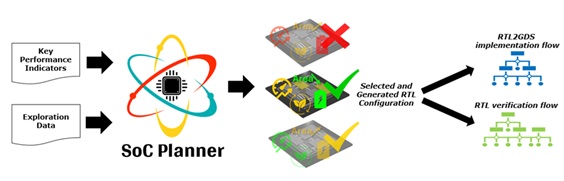
So, how does this thing actually work? It’s a fusion of several cutting-edge technologies. You’ve got CEA’s A-DECA for automated design space exploration, Defacto Technologies’ SoC Compiler for spitting out RTL (that’s the raw design code for the chip), and Innova’s PDM for wrangling the whole chaotic process. They’ve stitched these together into a single platform that claims to bridge the yawning chasm between high-level architectural ideas and the nitty-gritty of design implementation.
Traditionally, architects would dream up a design, pass it to implementation teams, who’d hand it back with a list of problems, leading to endless cycles of rework. SoC PLANNER promises to shortcut that agonizing loop. From mapping out architectural trade-offs to generating RTL code ready for synthesis and verification—it covers the entire pre-silicon design spectrum.
But here’s the kicker, the part that feels genuinely novel and frankly, overdue: SoC PLANNER injects an “eco-design footprint score” into the exploration process. This metric, which, according to the team, is unique in the chip design world, allows designers to weigh sustainability alongside power, performance, and area. Imagine picking a chip configuration not just because it’s 5% faster, but because it also slashes its environmental impact by 10%. That’s the promise.
Why Does This Matter for Real People?
For the engineers sweating over these designs, it means a potential reprieve from mind-numbing manual iterations. The claim is a 30-40% reduction in exploration time. That’s significant. It means getting products to market faster and potentially at a lower cost. For us on the receiving end, it could mean more power-efficient devices that last longer and have a smaller environmental footprint. It’s about getting the benefits of cutting-edge tech without quite as much of the planetary cost.
Let’s take a peek at a use case: PNeuro, a subsystem designed for energy-efficient deep neural network (DNN) inference in edge AI systems. Think smart cameras, voice assistants, or even sophisticated medical devices. SoC PLANNER crunched through a vast design space—cluster configurations, memory hierarchies, clocking schemes—and spat out optimized designs that slashed latency and energy consumption while keeping power in check. The RTL code was then automatically generated, ready for the next steps. This automates what used to be a months-long, highly specialized task.
The results consistently show configurations that cut latency and energy in tandem, keeping both dynamic and static power in check. The top-ranked configurations were then then automatically translated into RTL, ready for synthesis and simulation.
This isn’t just about incremental improvement; it’s about fundamentally changing the design paradigm. When sustainability is a first-class citizen in the design exploration process, we might finally start seeing chips that are designed with the planet in mind from day one, not as an afterthought.
The Skeptic’s Corner
Look, “eco-design footprint score” sounds great, but how is it calculated? What are the underlying assumptions? Without granular detail, it’s easy for this to become just another piece of corporate jargon. The effectiveness will hinge on the transparency and accuracy of this scoring system and how well it truly correlates with real-world environmental impact. Is it just measuring energy consumption during operation, or does it account for manufacturing and material sourcing? These are the questions that need rigorous answers before we declare this a green revolution.
Still, the potential is undeniable. If SoC PLANNER can deliver on its promise, it could democratize complex design choices, making high-performance, sustainable silicon more accessible. It’s a tool designed to help architects navigate an increasingly complex landscape, and for the first time, with a conscience.
What’s Next?
Early adopters are already getting their hands on a version of SoC PLANNER for validation. The success of these trials will be key. If it proves its mettle, we could see a significant shift in how chips are designed, moving from a purely PPA (Power, Performance, Area) centric approach to one that embraces environmental responsibility as a core design principle.
This feels like a genuine step forward, not just another incremental update. It’s a tool that acknowledges the dual pressures of market demands and planetary stewardship. The silicon age, it seems, is finally getting a conscience.
🧬 Related Insights
- Read more: Samsung’s 2nm Yields Stuck at 60%—Qualcomm Says No Thanks, Sticks with TSMC
- Read more: Nan Pao Joint Venture Hits Max Speed: What It Means for Your Devices
Frequently Asked Questions
What does SoC PLANNER actually do? SoC PLANNER is a design exploration solution that automates the process of finding optimal System-on-Chip (SoC) configurations by balancing performance, power, area, and cost, while uniquely incorporating an eco-design footprint score.
Will this tool replace SoC architects? No, it’s designed to augment their capabilities, automating complex iterations and providing structured insights, allowing architects to focus on higher-level strategic decisions.
How does SoC PLANNER address sustainability? It assigns an eco-design footprint score to design configurations, allowing designers to explicitly consider and optimize for sustainability alongside traditional metrics like power and performance during the exploration phase.